

Architectural 3D Animation: Freelancer vs Studio, A Project-Type Decision
A 90-second animation for a planning submission has a hard external deadline, a client who cannot accept a delivery miss, and a quality bar set by the submission authority. A 30-second social reel for a residential scheme has more flexibility on all three counts. The same developer might correctly choose a studio for the first and a freelancer for the second.
This post covers cost per second benchmarks, turnaround timelines, revision structures, the concrete risk of freelancer failure mid-project, and a project-type framework for making the decision.
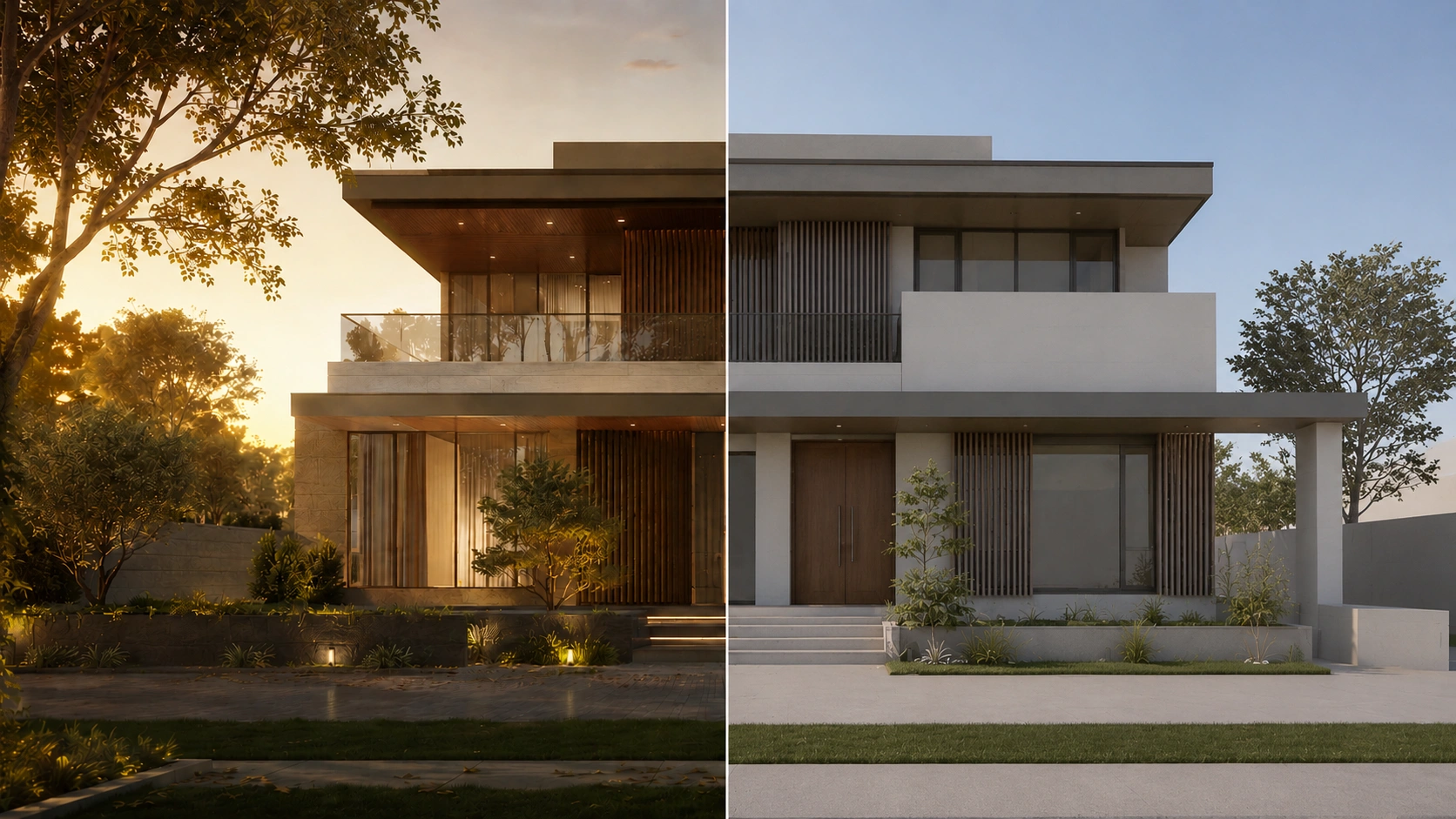
Cost Per Second and Per Minute: Benchmarks
Freelancer Rate Ranges
Freelancer rates for architectural 3D animation vary by experience level and output quality:
- Hourly rate: $30 to $150+ per hour, depending on specialist experience
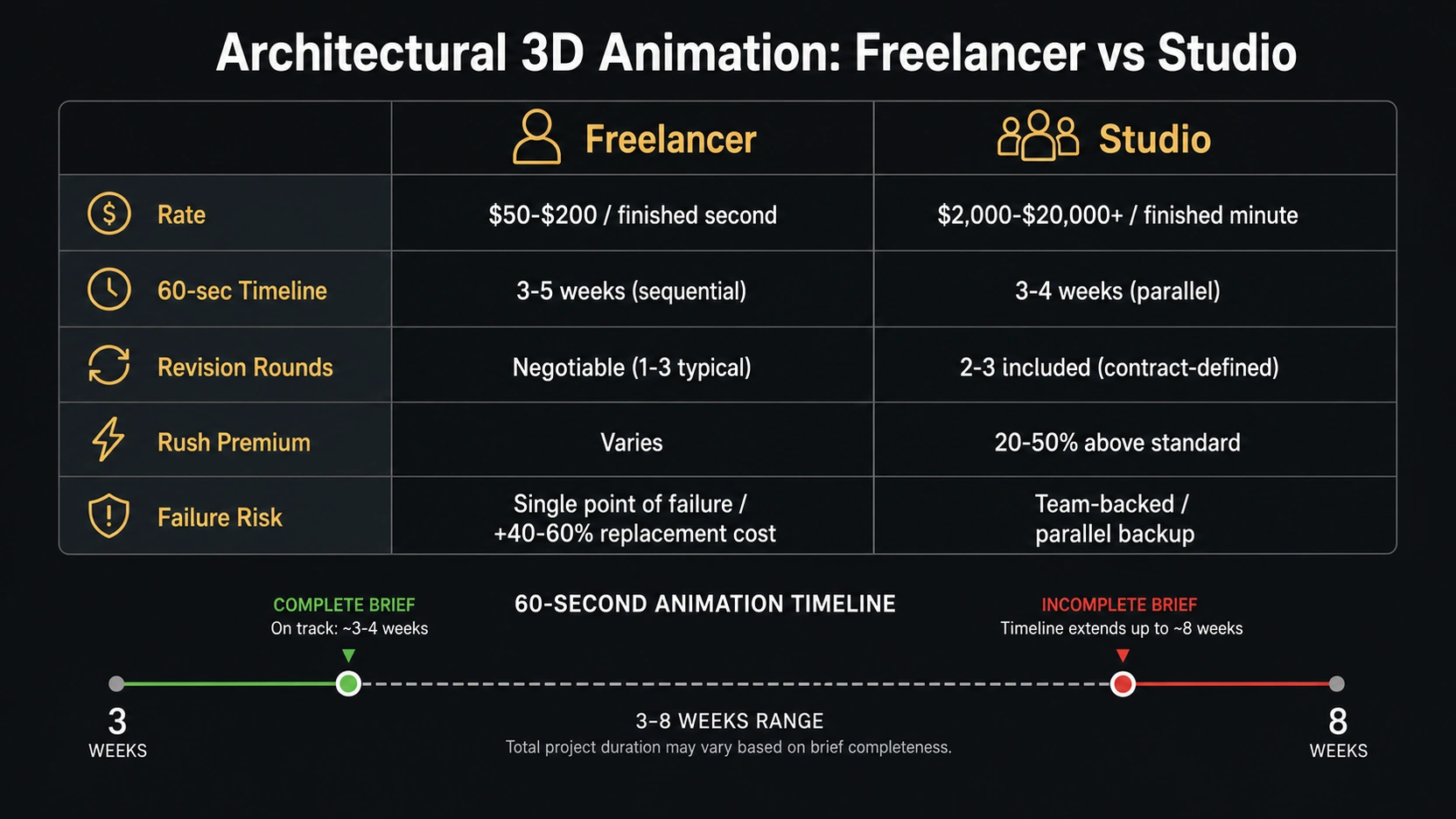
- Per-second rate (mid-range output): $50 to $200 per finished second of photorealistic architectural 3D animation
- Project-based pricing: many experienced freelancers quote per-project rather than per-second to account for setup, rendering, and revision time
At $100 per finished second, a 60-second architectural 3D animation costs approximately $6,000 before revisions. This is the mid-range freelancer rate for moderate complexity — exterior flyover, daytime lighting, no dynamic water or foliage simulation.
Studio Rate Ranges
Studios price architectural 3D animation by project or by finished minute:
- Per finished minute: $2,000 to $20,000+, depending on photorealism, output length, and scene complexity
- Premium tier (developer-grade, planning-quality): $8,000 to $20,000 per finished minute for scenes with complex lighting, dynamic elements, and multiple interior and exterior sequences
- Rush premium: 20 to 50% above the standard rate for compressed timelines
At $8,000 per finished minute, a 60-second animation costs $8,000 for studio-grade output – approximately 33% above a mid-range freelancer. What that premium buys is covered in the risk and workflow sections below.
Turnaround Times and Workflow Structure
Standard Timelines
A standard 60-second architectural 3D animation takes 3 to 8 weeks from a complete brief to final delivery, regardless of whether a freelancer or studio produces it. The timeline spread reflects project complexity, not the production route.
The critical variable is the brief. A complete brief – CAD or Revit files, material specifications, camera path descriptions, approved reference images, compresses delivery time at both ends of the market. An incomplete brief adds 1 to 3 weeks of clarification at any quality level.
Sequential vs Parallel Production
Freelancer workflow: sequential. One artist handles modelling, then lighting, then animation, then rendering, then compositing. Each stage waits for the previous. For a 60-second animation, this is typically 3 to 5 weeks for a mid-range freelancer.
Studio workflow: parallel. Modelling, lighting setup, and animation path planning run simultaneously across team members. Rendering begins on completed sections while others are still in production. A studio with a complete brief can deliver a 60-second animation in 3 to 4 weeks at higher quality.
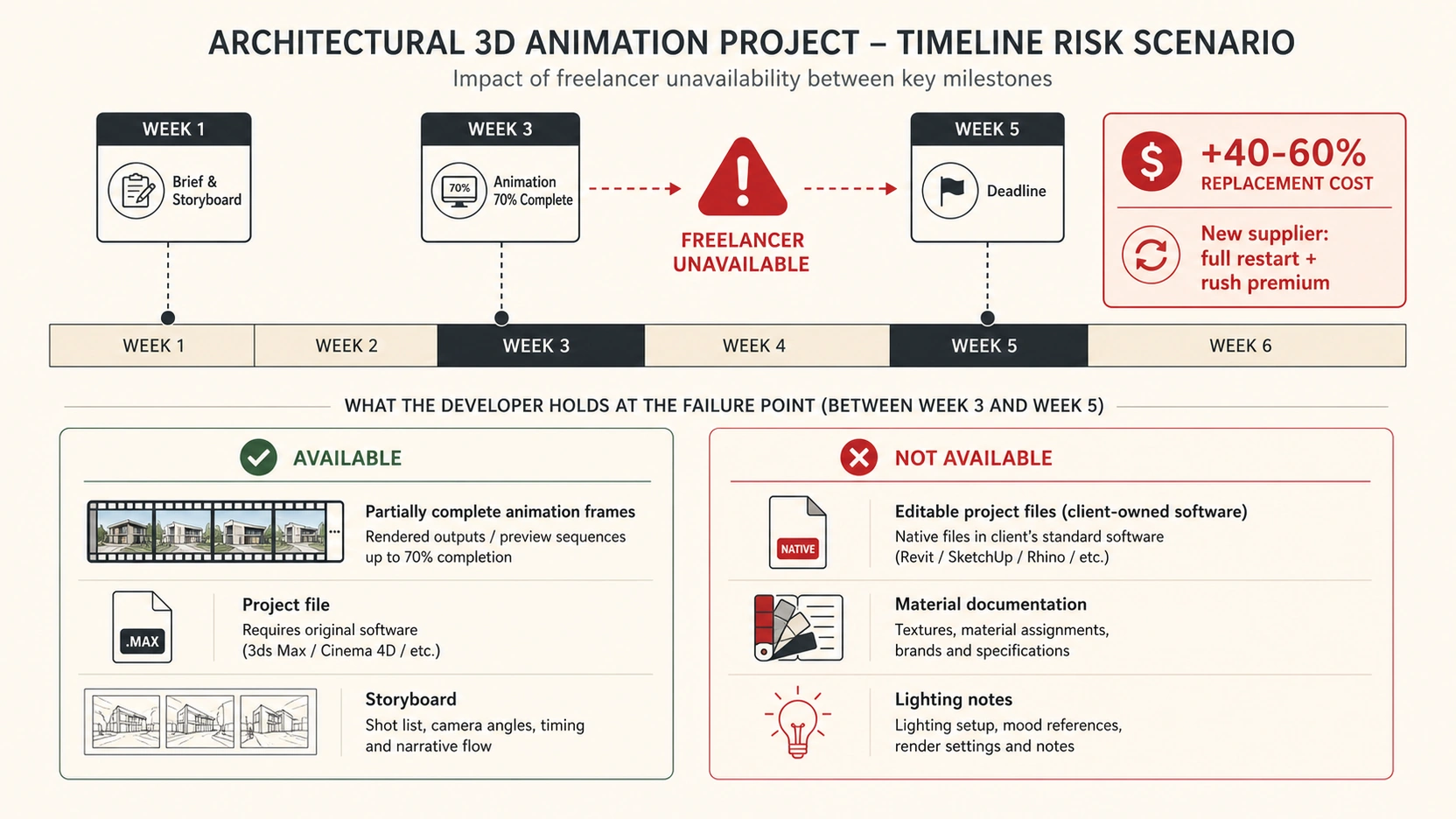
The parallel workflow advantage is most visible on architectural 3D animations above 90 seconds, or on projects containing multiple distinct sequences – exterior approach, courtyard, interior walkthrough, where different scenes can be modelled and lit simultaneously. For camera movement and pacing strategy in these sequences, see our guide on 3D architectural walkthrough camera speeds.
Revision Structures and Quality Control
What Standard Revisions Cover
Standard professional quotes, freelancer and studio typically include 2 to 3 revision rounds. What those rounds cover matters more than the number.
Minor revisions (within scope for included rounds):
- Material colour adjustments (wall paint, soft furnishings, flooring)
- Furniture placement within existing rooms
- Lighting intensity or colour temperature tweaks
- Camera speed or timing adjustments within the approved path
Major changes (typically out of scope, billed separately):
- Camera path changes after the animation is approved at storyboard stage
- Floor plan alterations that require re-modelling of room geometry
- Addition of a new sequence (new exterior angle, new interior space)
- Dynamic element additions (foliage wind, water features, moving people) added after production begins
The most common source of revision cost overrun: approving the storyboard without reviewing the camera path against the final design, then requesting camera path changes after the animation is 60% complete.
Studio QA vs Freelancer Self-Review
A studio applies a QA pass at each production stage: model review before lighting, lighting review before animation, composite review before delivery. This catches errors before they are rendered into 100 or more frames.
A freelancer self-reviews. Self-review is not a quality failure, experienced freelancers with strong portfolios produce excellent output. The risk is that the feedback loop is one person wide. A missed material inconsistency or a clipping issue in a transition goes to the client rather than to an internal reviewer.
The Single Point of Failure: What Freelancer Risk Actually Looks Like
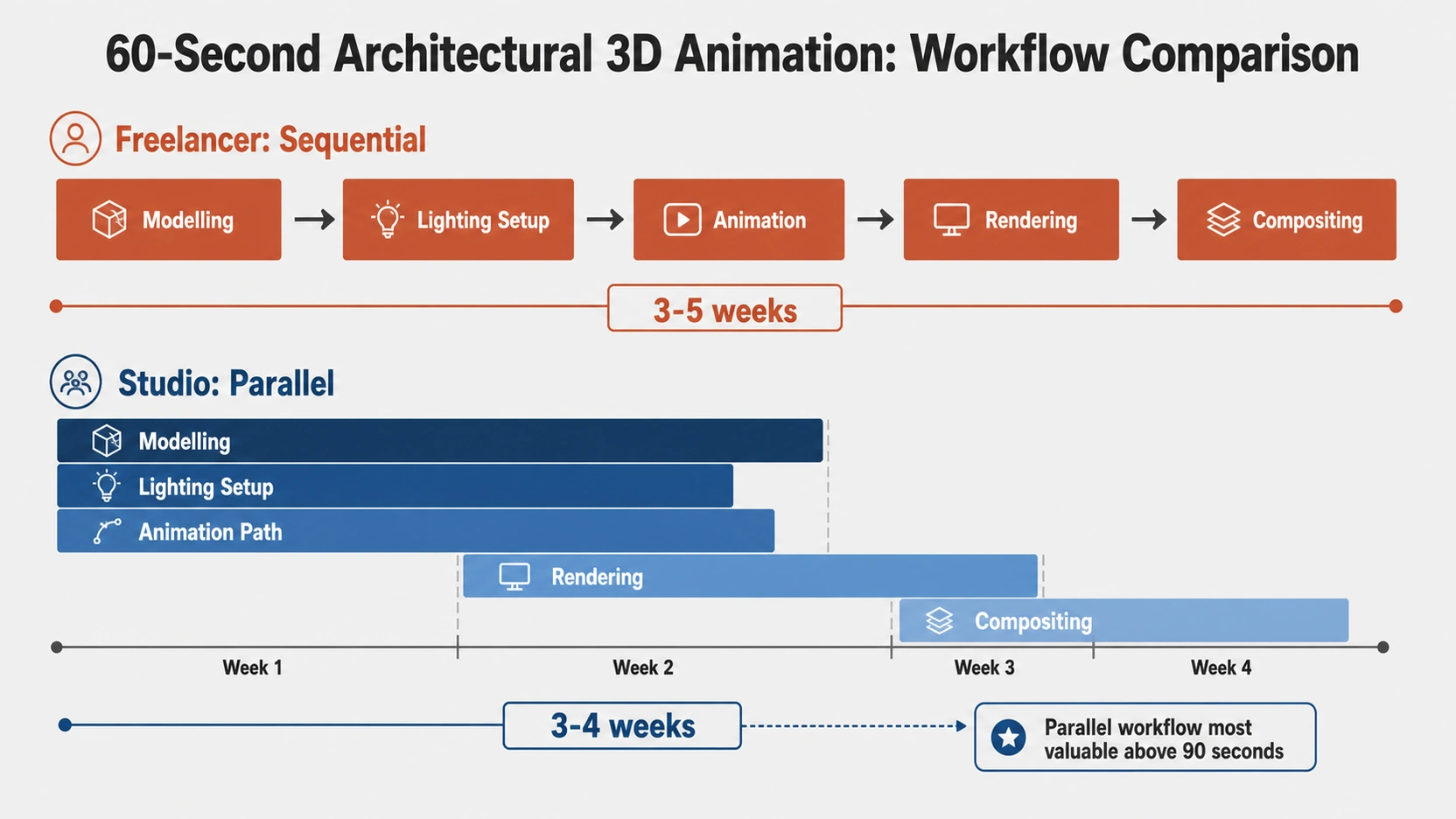
A developer books a freelance 3D artist for a 60-second exterior animation for a planning submission with a hard deadline in 6 weeks. At week 4, with the animation 70% complete, the freelancer becomes uncontactable. The developer holds:
- A partially complete animation in a project file (typically a 3ds Max or Blender scene)
- No access to the software licence to open and continue the file
- No transferable project documentation – no storyboard, no lighting notes, no material list
- A deadline in 14 days
- The full replacement cost of restarting with a new supplier
Replacement cost in this scenario is typically 40 to 60% higher than the original project cost. The new supplier cannot reuse the incomplete work without the original software environment. Starting from scratch under a 14-day deadline triggers rush premiums on top of the full project rate.
Mitigation if using a freelancer: require weekly project file exports in an agreed format, written storyboard sign-off at the brief stage, and a contract clause specifying delivery of editable project files at each agreed milestone. See CGarchitect for freelancer contract best practices in the archviz community.
A Project-Type Decision Framework
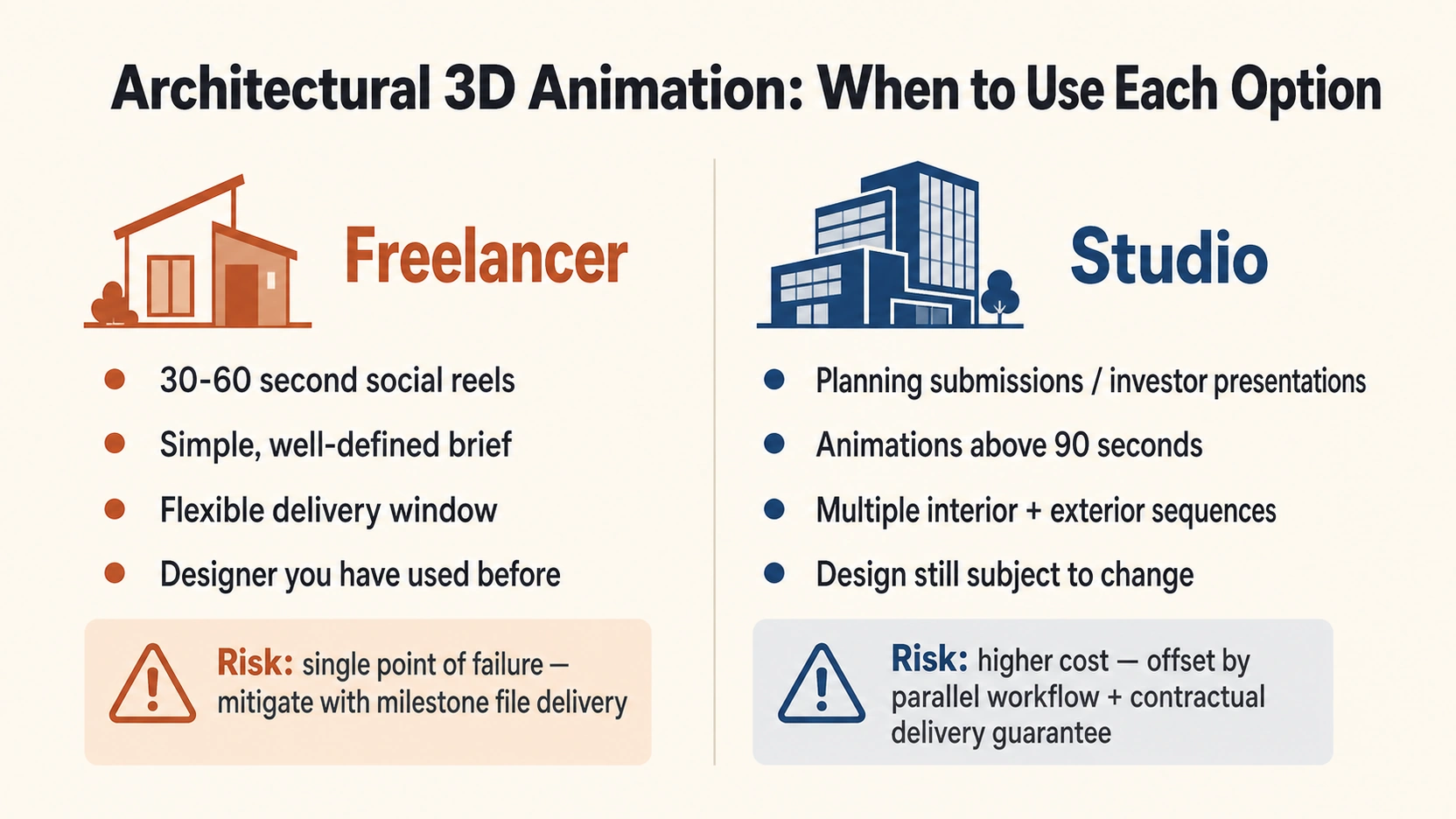
When to Use a Freelancer
Use a freelancer for architectural 3D animation when:
- The project is a 30 to 60-second social reel with a flexible delivery window and no hard external deadline
- The brief is simple, well-defined, and change-unlikely — a single exterior angle, approved design, fixed material palette
- You have used this specific freelancer before and have direct experience of their reliability under deadline pressure
- A quality miss or delivery delay is recoverable without financial or reputational penalty
When to Use a Studio
Use a studio for architectural 3D animation when:
- The output is for a planning submission, investor presentation, or public launch with a hard external deadline
- The project is above 90 seconds, involves multiple interior and exterior sequences, or includes dynamic elements
- You are briefing from an incomplete design still subject to change during production
- A delivery miss or quality failure carries financial or reputational consequences that outweigh the cost premium
At RenderInfinity, architectural 3D animation projects run on a parallel workflow with a dedicated project manager, three included revision rounds for minor adjustments, and milestone-based delivery of editable project files. Visit our architectural animation services page for studio-grade production packages.
What to Know
- Freelancer rates: $50 to $200 per finished second (mid-range), $30 to $150/hour. Studio rates: $2,000 to $20,000+ per finished minute. Rush premium: 20 to 50% at both tiers.
- Standard 60-second animation timeline: 3 to 8 weeks from a complete brief, for both routes. An incomplete brief adds 1 to 3 weeks. A complete brief is the single most controllable timeline variable.
- Freelancers work sequentially (3 to 5 weeks). Studios work in parallel (3 to 4 weeks). Parallel workflow advantage is most visible above 90 seconds or with multiple distinct sequences.
- Standard revision rounds: 2 to 3 included. Minor adjustments in scope; structural changes (camera path, floor plan alterations, new sequences) are out of scope and billed separately.
- Freelancer single-point-of-failure risk: unavailability mid-project produces 40 to 60% replacement cost increase. Mitigation: weekly file exports, milestone editable file delivery, written storyboard sign-off in the contract.
Frequently Asked Questions
How much does architectural 3D animation cost per second?
Freelancer rates run $50 to $200 per finished second for mid-range photorealistic output. Studio rates convert to approximately $33 to $333 per finished second at $2,000 to $20,000 per finished minute. The range reflects complexity — a single exterior flyover with static elements sits at the lower end; a multi-sequence animation with foliage wind, moving water, and mixed interior and exterior shots sits at the upper end.
How long does a 60-second architectural 3D animation take?
3 to 8 weeks from a complete brief to final delivery, for both freelancer and studio. The spread reflects project complexity. An incomplete brief — missing CAD files, unspecified materials, or an undefined camera path — adds 1 to 3 weeks at either end. A studio with a parallel workflow typically delivers at the shorter end of this range for a well-briefed project.
How many revision rounds are standard in architectural 3D animation?
Professional quotes typically include 2 to 3 revision rounds covering minor adjustments: material colour, furniture placement, lighting tweaks, camera speed within the approved path. Structural changes — camera path alterations after storyboard approval, floor plan changes, new sequences — are out of scope and billed separately. The most common cost overrun: approving the storyboard without reviewing the camera path, then requesting changes after animation is 60% complete.
What is the risk of using a freelancer for architectural 3D animation?
The primary risk is single-point-of-failure. If the freelancer becomes uncontactable mid-project, the client holds partially complete files in software they don’t own, with no transferable project documentation. Replacement cost is typically 40 to 60% higher than the original rate. Mitigation: weekly project file exports, written storyboard sign-off, and a contract clause specifying editable file delivery at each agreed milestone.
When should I use a studio instead of a freelancer for architectural 3D animation?
Use a studio for planning submissions, investor presentations, or public launches with hard external deadlines. Use a studio for projects above 90 seconds with multiple sequences, or where the design is still subject to change during production. Use a freelancer for short social reels with flexible timelines, simple change-unlikely briefs, and where you have direct prior experience with that artist’s reliability.
Conclusion
Architectural 3D animation at any length involves a meaningful budget and a meaningful deadline. The freelancer route offers a lower cost base and direct artist communication. The studio route offers parallel production, internal QA, contractual accountability, and protection against single-point-of-failure risk. The correct choice is determined by the project’s risk profile, not its budget line.
At RenderInfinity, architectural 3D animation projects are handled by a dedicated team with a parallel workflow and milestone-based file delivery at every stage. If you are evaluating production options for an upcoming animation, visit our architectural animation services page or send us your project brief.