

Sound Design for 3D Architectural Animations: The Three-Layer Method
Why Sound Design Matters in 3D Architectural Animations
Professional studios allocate 7 to 10% of total animation budget to sound design. On a $5,000 project, that is $350 to $500. On a $15,000 project, it is $1,050 to $1,500. This is not the cost of a custom film score. It covers the time and licensing cost of correctly sourcing, layering, and syncing three audio tracks to a precisely timed edit.
The investment is not arbitrary. Sound communicates spatial qualities that visuals cannot convey alone. The reverb tail in a grand entrance hall tells the viewer the space is large and hard-surfaced before any furniture or scale reference appears in frame. The soft HVAC hum in a residential bedroom confirms the building is inhabited and working. The ambient birdsong through glazing in a living room confirms the facade behind the camera is glazed and the outdoor environment is quiet. These are not decorative additions. They are information that justifies the architecture.
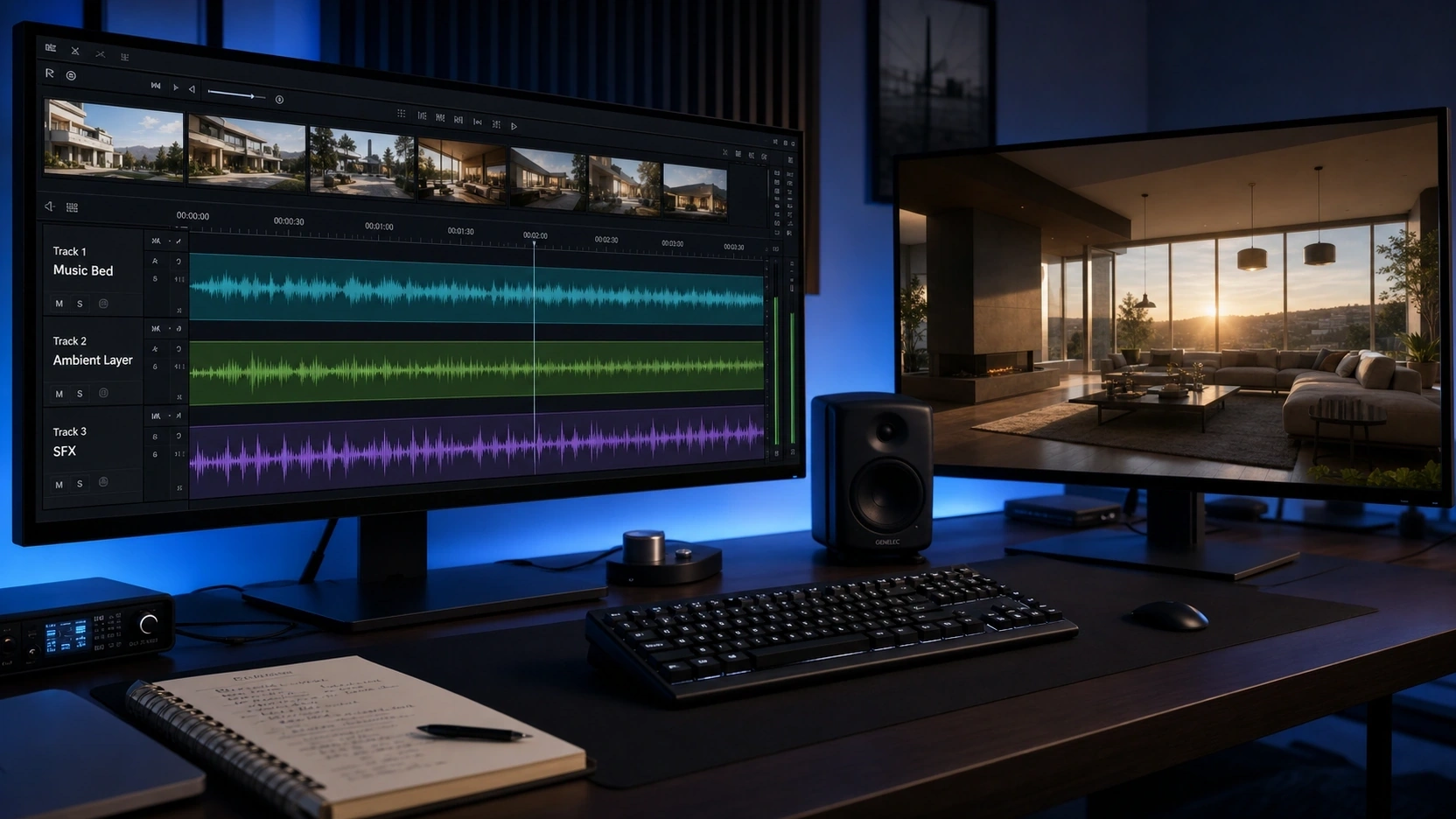
The Three-Layer Audio Stack
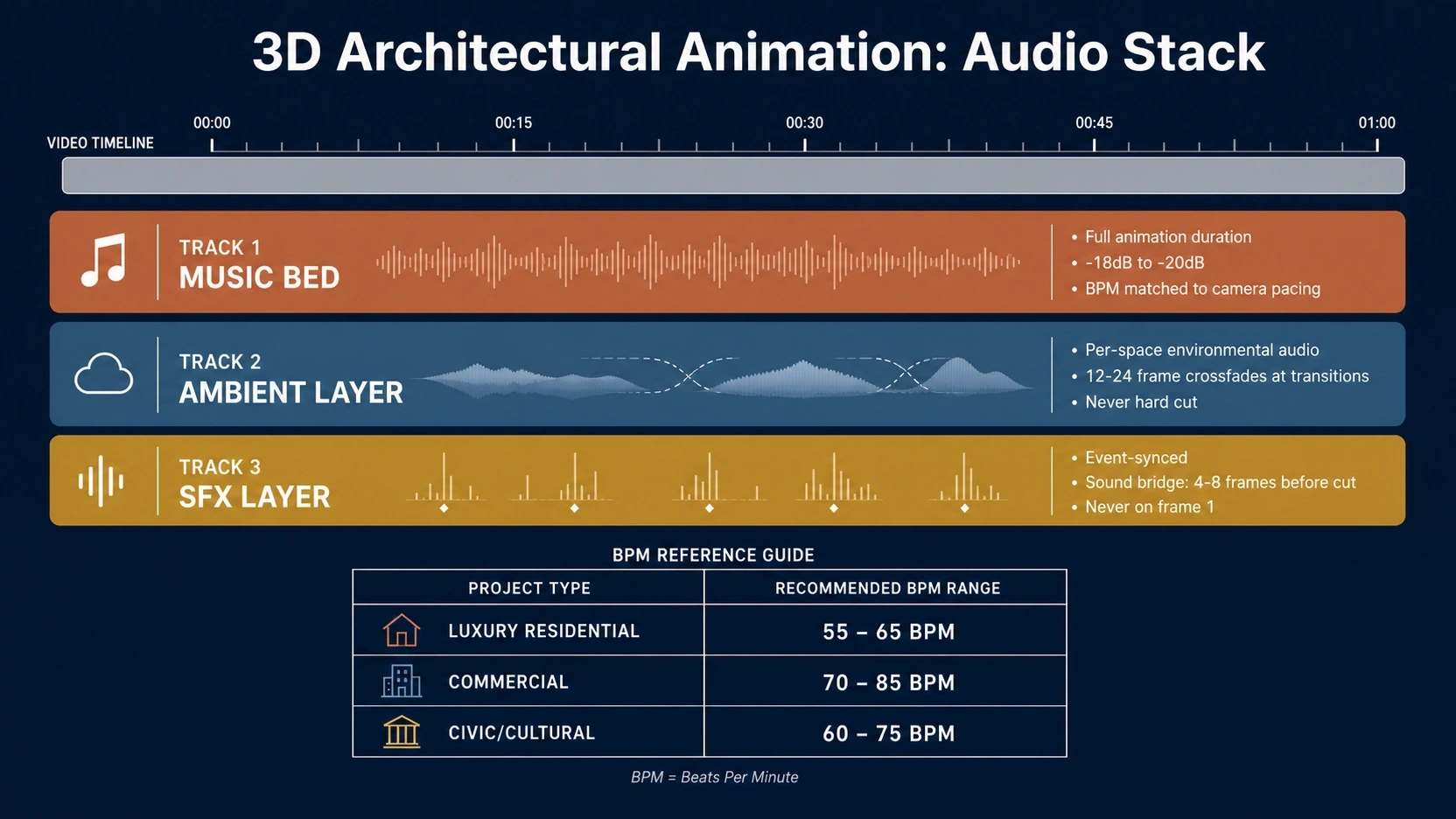
Layer 1 – The Music Bed
The music bed is the foundation. It sets emotional tone for the entire animation and occupies the full duration from the first frame to the last. It is not cut on and off between rooms or scenes.
BPM selection by project type:
- Luxury residential / boutique hotel: 55 to 65 BPM. Slow, clean, warm. Instrumentation: piano, cello, ambient synth pads. This tempo maps onto camera pacing of 8 to 12 seconds per shot — each shot holds for a natural musical phrase without the music feeling like it is waiting for the cut.
- Commercial / mixed-use: 70 to 85 BPM. Controlled rhythm, modern. Electronic or hybrid orchestral. Aligns with faster camera pacing of 4 to 6 seconds per shot.
- Public building / civic / cultural: 60 to 75 BPM. Neutral and expansive. Orchestral ambient or minimal post-classical.
At 60 BPM exactly, one beat equals one second. Set the DAW grid to 60 BPM and it becomes a direct proxy for video seconds — placing a musical phrase at beat 32 is the same as placing it at 00:32 in the edit. Set the BPM before searching for music. Find tracks that match the established BPM rather than working backwards from a track you already like.
In the final mix, the music bed sits at -18dB to -20dB to leave headroom for the ambient and SFX layers. At this level, it is present and tonally correct without masking the spatial audio above it.
Layer 2 – The Ambient Layer
The ambient layer grounds the viewer in the physical space. Without it, a 3D architectural animation sounds like a music video: a visual sequence with a music track, not an architectural experience.
Ambient sounds by space category:
- Interior residential: soft HVAC hum at -35dB, faint birdsong through glazing at -28dB to -30dB. If a walking sequence is included, subtle floor resonance at the footstep rhythm.
- Exterior: low wind at -22dB to -25dB, distant traffic at -30dB to -40dB below the music bed level, water if a pool or fountain feature appears in frame.
- Commercial lobby: low crowd murmur at -25dB, elevator ping at transition cut points, HVAC at -35dB.
These dB values are mix position targets relative to the music bed. They define where each ambient element sits in the mix hierarchy so the space audio remains present without competing with the music.
The ambient layer never cuts hard at room transitions. When the camera moves from a residential interior to an exterior, the interior ambient fades out over 12 to 24 frames as the new ambient rises in. A hard cut on the ambient layer sounds like a splice even when the visual cut is clean.
Layer 3 – The SFX Layer
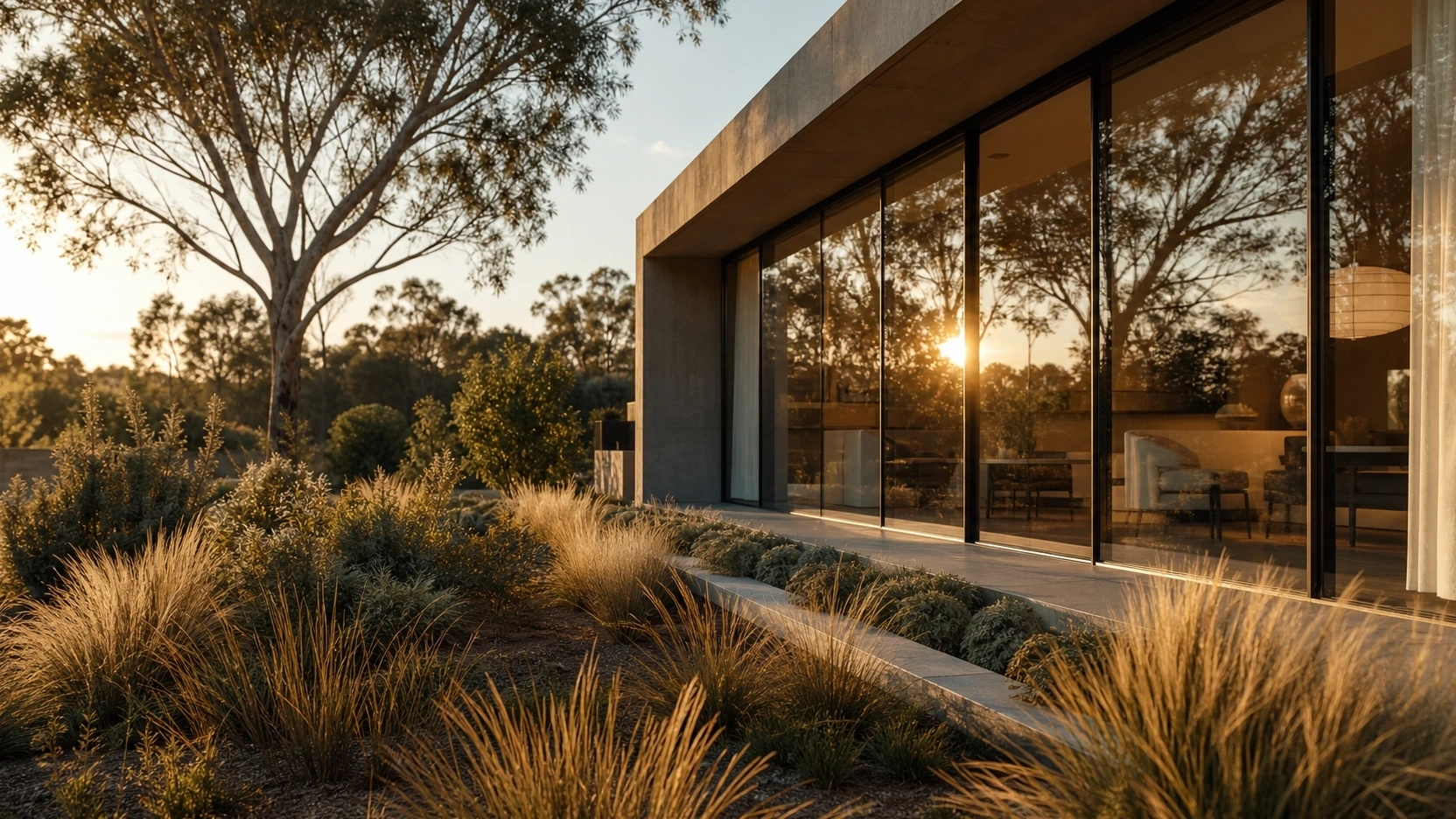
The SFX layer contains point-specific audio events synced to camera movements and visual transitions.
Common SFX events in 3D architectural animations:
- Door opening: soft latch click followed by a subtle air-pressure whoosh. 50ms to 100ms delay between click and whoosh, matching how a real door sounds as the seal breaks before the slab swings.
- Exterior transition: a brief wind gust that rises from silence 8 frames before the cut to exterior and resolves 4 to 6 frames after. The viewer hears the exterior before they see it.
- Room reveal: as the camera pushes through a doorway, the ambient level rises 4 to 6dB over 12 frames as the room opens. The room’s acoustic character expands with the frame.
- Material close-up: at a detail shot, a subtle texture sound at the cut point — concrete grain, timber surface, glass resonance. This makes materials feel physically real rather than rendered.
The sound bridge rule governs all SFX placement: the initiating sound lands 4 to 8 frames before the visual cut; the peak or resolution lands 4 to 8 frames after. No SFX event falls exactly on frame 1 of a cut. Audio that hits exactly at the cut feels mechanical. Audio that anticipates and resolves the cut feels cinematic.
BPM, Licensing, and the Audio Brief Document
Selecting the Right BPM
BPM selection is not about musical taste. It is about how audio tempo maps onto the pacing of the visual edit.
A luxury residential animation typically paces at 8 to 12 seconds per shot. At 60 BPM, each shot holds for 8 to 12 beats, a natural musical phrase. This is why 55 to 65 BPM feels correct for this content: the music breathes with the visual pace rather than fighting against it. A commercial animation cuts faster at 4 to 6 seconds per shot — 70 to 85 BPM keeps the music feeling present and energetic without outpacing the edit.
For more on how camera pacing and shot duration interact with the visual edit, see our breakdown of 3D architectural walkthrough camera speeds.
Licensing for Client-Facing Deliverables
Any audio in a deliverable that a client shows to their audience is a commercial use. This covers websites, investor presentations, sales centre screens, and social media. Royalty-free does not mean free-of-cost. It does not automatically include commercial rights.
Standard licensing options:
- Subscription libraries (studios producing 4 or more animations per year): Epidemic Sound (unlimited commercial downloads, Content ID clearance), Artlist (unlimited commercial use with synchronization rights), Motion Array (audio plus templates).
- One-time licensing (individual projects): AudioJungle (Envato), Musicbed. Each track licensed per project with explicit commercial rights.
- Free options: Freesound.org for specific SFX (check each file’s license individually). YouTube Audio Library tracks marked “for commercial use.”
Keep a license certificate folder for every track used in a commercial project. If a client uses the animation beyond the agreed channel scope, the license certificate is the studio’s legal protection.
The Audio Brief Document
Sound design problems in 3D architectural animations almost always trace back to absent briefing. An editor who receives no audio brief works by intuition. An editor who receives a two-paragraph brief delivers the correct emotional outcome on the first pass.
An audio brief for architectural animation contains three elements:
- Emotional target: one sentence describing what the viewer should feel at the end. For example: “The viewer should feel that this home is calm, light, and aspirational.” This is the sonic goal, not a genre description.
- Three reference tracks: specific track links from a music library, not genre descriptions. Genre descriptions are subjective. Three track links are concrete and eliminate interpretation.
- Space list: a table of each space in the animation with its ambient category — interior residential, exterior, commercial. This briefs the ambient layer scene by scene.
This document is produced at the storyboard stage, before the edit begins. Sound design that starts at the export stage is revision-heavy. Sound design that starts at storyboard is completed before the client review.
At a Professional 3D Visualization Studio, every animation project includes an audio brief before visual editing begins. The brief specifies BPM range, reference tracks, and the ambient category for each space. It is part of the project brief, not an afterthought.
For specialist architectural animation services including audio production coordination, see our architectural animation services page.
What to Know
- Three-layer audio stack for 3D architectural animations: music bed (emotional foundation at -18dB to -20dB), ambient layer (spatial grounding per space category), SFX layer (event-synced, sound bridge technique). Never collapse to a single track.
- BPM by project type: 55 to 65 for luxury residential, 70 to 85 for commercial. Set BPM in the DAW first, then search for matching music.
- Ambient layer crossfades 12 to 24 frames at room transitions. No hard cuts. SFX bridges the cut: initiating sound 4 to 8 frames before, peak 4 to 8 frames after.
- All audio in client-facing deliverables is a commercial use. Epidemic Sound and Artlist subscriptions cover unlimited commercial licensing. Keep license certificates for every project.
- The audio brief is written at the storyboard stage: emotional target (one sentence), three reference track links, space-by-space ambient category table.
Frequently Asked Questions
What music should I use for 3D architectural animations?
The music depends on project type and camera pacing. Luxury residential animations use 55 to 65 BPM with warm instrumentation: piano, strings, ambient pads. Commercial animations use 70 to 85 BPM with a more rhythmic, modern sound. Set BPM in the DAW before searching for music. Source from Epidemic Sound or Artlist with a commercial-use subscription to cover client-facing deliverables.
Do I need to pay for music in an architectural animation?
Yes, for any client-facing deliverable. Royalty-free does not mean free-of-cost and does not automatically include commercial rights. An Epidemic Sound or Artlist subscription provides unlimited commercial-use licensing for $150 to $200 per year. One-time licensing through AudioJungle or Musicbed covers individual projects. Free options exist but require checking commercial rights per track.
What ambient sounds should I include in an interior architectural animation?
Interior residential: soft HVAC hum at -35dB, faint birdsong through glazing at -28dB to -30dB. Commercial lobby: low crowd murmur at -25dB, elevator ping at cut points. Exterior: wind at -22dB to -25dB, distant traffic at -30dB to -40dB below the music bed. Always crossfade ambient sounds 12 to 24 frames at room transitions. No hard cuts on the ambient layer.
How do I sync sound effects to camera cuts in architectural animation?
Use the sound bridge technique: initiating SFX sound 4 to 8 frames before the cut, peak or resolution 4 to 8 frames after. Never place an SFX event on exactly frame 1 of a visual cut. For room reveals, raise ambient level 4 to 6dB over 12 frames as the doorway opens. For exterior transitions, start a wind gust rising 8 frames before the cut to exterior.
What is an audio brief for architectural animation and when should it be created?
An audio brief is produced at the storyboard stage, before editing begins. It contains: one sentence defining the emotional target, three specific reference track links, and a table of each space with its ambient category. It prevents misalignment between the visual editor and sound designer before a single audio clip is placed on the timeline.
Conclusion
Sound design is not the final step in producing 3D architectural animations. It is a parallel track that starts at the storyboard and runs to delivery. The music bed, ambient layer, and SFX layer are briefed, sourced, and mixed in sequence, each serving a specific function in the viewer’s spatial and emotional experience of the space.
At RenderInfinity, every animation project includes an audio brief before the visual edit begins. If you are planning an architectural animation and want audio that supports the design intent rather than underlining it with a generic stock track, visit our architectural animation services page or contact us with your project brief.