



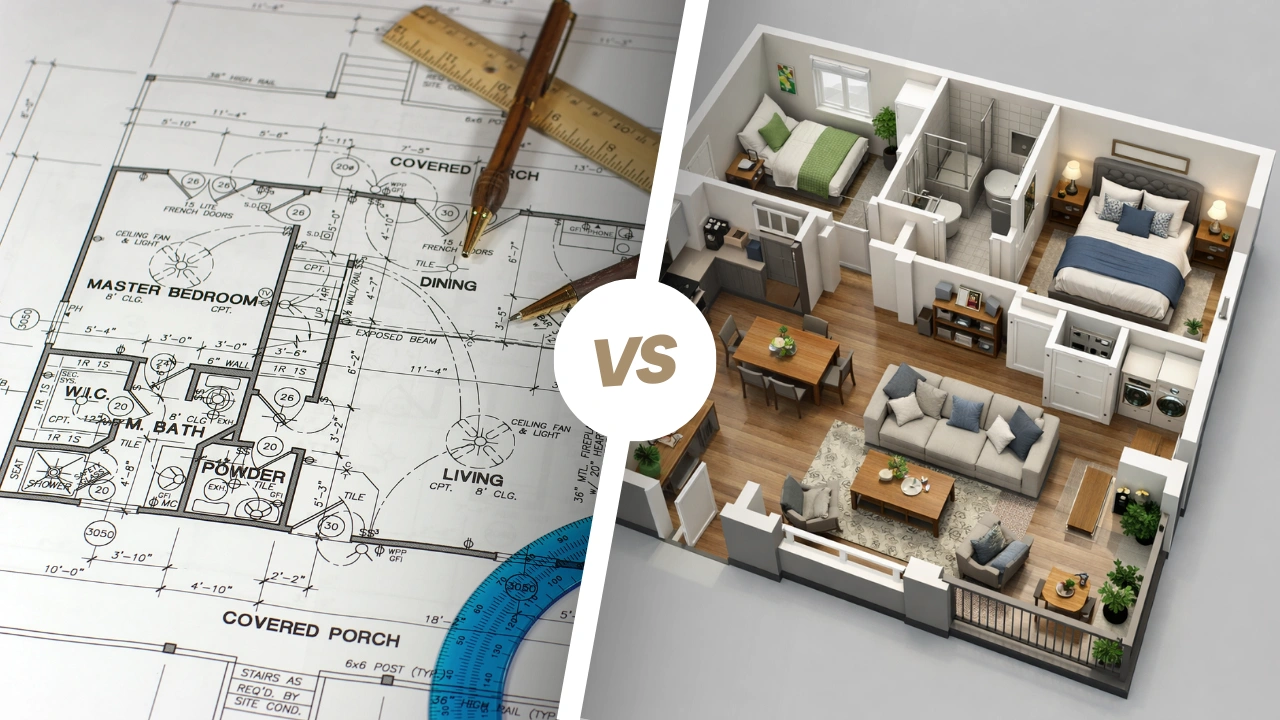
Picture this: You’re sitting across from a client, pointing at lines and symbols on a flat blueprint, trying to explain how their future home will feel. They nod politely, but their face tells a different story. They’re struggling to connect those geometric shapes to the space where they’ll actually live. This happens in architecture firms and real estate offices daily, and it highlights a fundamental limitation of traditional design communication.
A 3D floor plan transforms abstract architectural drawings into something anyone can understand immediately. Unlike conventional 2D blueprints that show only the bird’s-eye outline of walls and openings, 3D floor plans add depth, perspective, and realism. They reveal how rooms connect, how light fills spaces, and how furniture actually fits within the layout. For architects, real estate developers, and homeowners navigating design decisions, this shift from flat diagrams to dimensional representations changes everything about how projects move forward.
This article examines seven specific ways that 3D floor plan design delivers practical advantages over its 2D counterpart.
A 3D floor plan is a representation of a building’s layout that shows walls, rooms, and architectural features from an elevated perspective with depth and volume. Created using specialized rendering software, these visualizations incorporate realistic elements like furniture placement, material textures, lighting conditions, and color schemes. Unlike traditional blueprints that require training to interpret, a 3D home floor plan communicates spatial relationships intuitively. You can see how a kitchen opens to a dining area, how natural light enters through windows, or whether a sectional sofa will overwhelm a living room. This approach bridges the gap between technical documentation and human perception, making floor plan rendering services increasingly essential across residential and commercial projects.
3D architectural visualization has fundamentally changed how design professionals communicate with clients who lack technical backgrounds.

Most people cannot mentally translate flat blueprints into three-dimensional spaces. They look at a 2D floor plan and see shapes, not rooms, which creates uncertainty during what should be exciting project milestones. When someone can’t visualize the outcome, they hesitate to commit or request changes late in the process when modifications become expensive.

A 3D floor plan eliminates this translation work entirely. Clients immediately grasp room proportions, ceiling relationships, and how spaces flow into each other. A homeowner reviewing their future living room can see not just the square footage but the actual volume – how the 10-foot ceilings create openness, how the corner windows frame natural light, how the space accommodates their sectional and coffee table without feeling cramped. This clarity builds confidence in design decisions from the start.
One of the most common questions during design review goes something like: “Will my dining table fit here?” With 2D plans, this requires measuring, calculating, and imagining – often incorrectly. Clients worry about buying new homes or approving renovations because they can’t picture their belongings in the space.
3D floor plan design solves this by showing furniture at accurate scale within the rendered environment. Interior designers use this capability to demonstrate layout options, and homeowners gain certainty about what works before construction begins.
Benefits :

Misunderstandings about 2D plans create a expensive problem: clients approve designs they don’t fully comprehend, then request changes during construction when they finally see the physical space taking shape. These change orders disrupt timelines, increase costs, and frustrate everyone involved.
Real estate floor plans rendered in 3D dramatically reduce this issue. When clients clearly understand what they’re approving, they make decisions confidently the first time. Architects spend less time explaining concepts repeatedly, and builders face fewer mid-construction modifications. Research shows that design miscommunication remains one of the top causes of project delays and budget overruns, making visual clarity not just convenient but financially significant.
Real estate developers selling off-plan properties or pre-construction units face a unique challenge: convincing buyers to commit to spaces that don’t physically exist yet. Traditional 2D blueprints don’t inspire confidence or emotional connection. They certainly don’t sell properties.
3D floor plans transform marketing materials by showing potential buyers exactly what they’re purchasing. Buyers browse listings online and instantly understand layouts, imagine themselves in the space, and differentiate between similar properties. For developers and agents, this means:
3D rendering for real estate has become standard practice for developers who want to maximize sales velocity and achieve premium pricing.
A 2D floor plan can indicate window placement, but it cannot show how afternoon sunlight streams across a hardwood floor or how pendant lights illuminate a kitchen island. It displays wall locations but not whether those walls feature smooth plaster, exposed brick, or wood paneling. These sensory elements affect how people experience spaces, yet traditional blueprints ignore them completely.
Three-dimensional floor plan rendering incorporates these crucial details. Clients see how natural light changes room ambiance throughout the day, how material choices affect visual warmth, and how finishes coordinate across connected spaces. For luxury residential projects and commercial spaces where atmosphere matters as much as layout, this capability proves invaluable. Designers can test lighting schemes and material combinations digitally, refining aesthetics before any physical work begins.
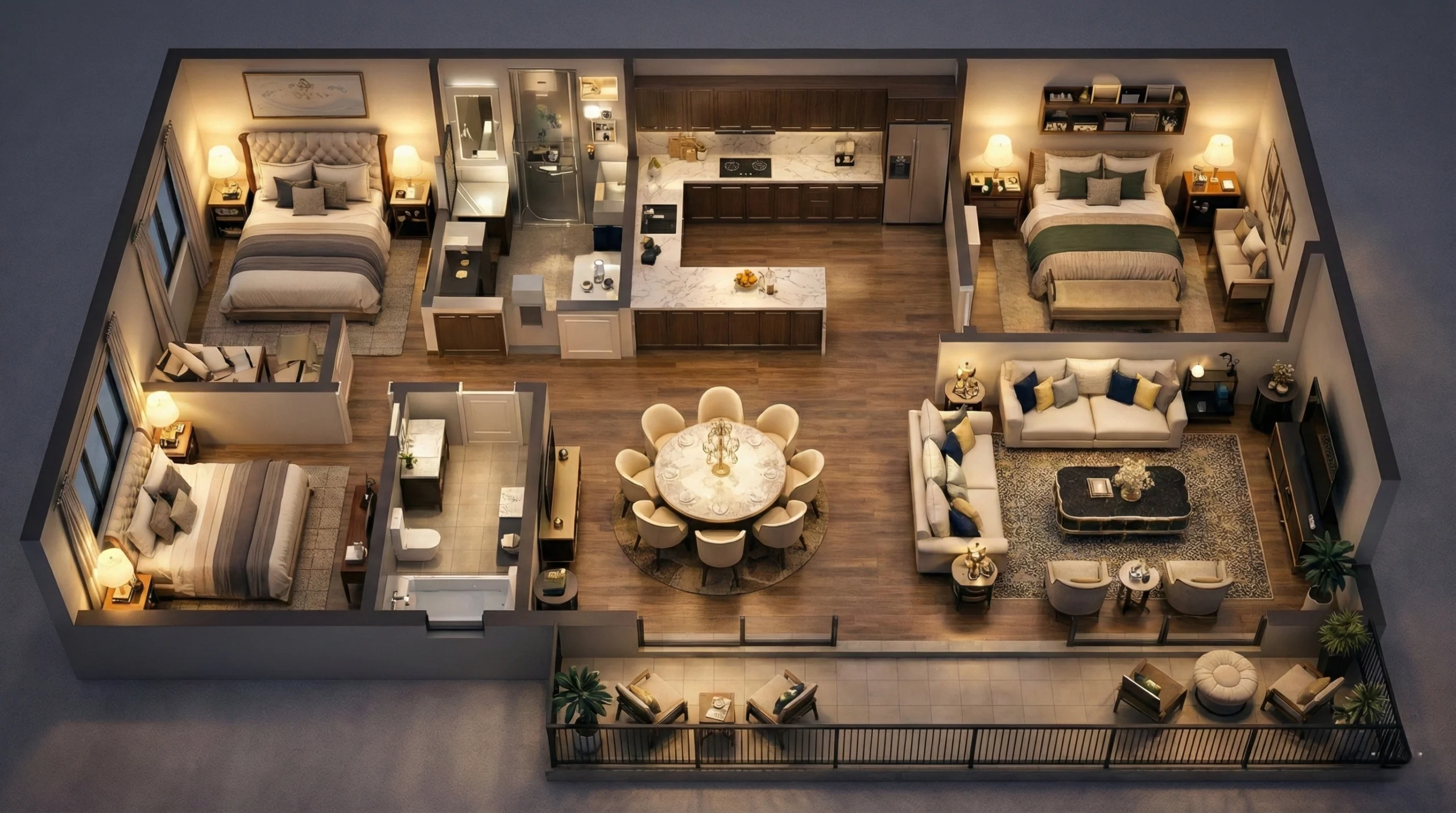
Construction projects involve multiple professionals who need to align on the same vision: architects designing structures, interior designers selecting finishes, builders executing construction, and clients making final decisions. When each party interprets 2D plans differently, coordination breaks down.
A 3D floor plan provides a single, clear reference point everyone understands identically. Project meetings become more productive when participants discuss a shared visual rather than debating interpretations of abstract drawings. Specific collaboration benefits include:
Collaborative design workflows increasingly rely on visual tools that eliminate ambiguity between specialized team members and non-technical stakeholders.

Client expectations have evolved. Twenty years ago, blueprints satisfied most residential clients. Today, people accustomed to sophisticated visualizations in every other aspect of their lives expect the same from design professionals. Firms still relying exclusively on 2D documentation risk appearing outdated.
Offering comprehensive 3D floor plans signals that a practice keeps pace with industry standards and invests in client experience. This matters particularly when competing for projects where multiple firms pitch similar capabilities. The architect or developer who helps clients visualize outcomes most effectively often wins the commission, regardless of whether their technical skills exceed competitors. It’s simply good business practice in a market where professional architectural visualization has shifted from specialty service to baseline expectation.
While 2D plans still serve technical purposes during permitting and construction documentation, 3D versions excel in client-facing situations:
The seven advantages outlined above demonstrate why 3D floor plans have moved beyond novelty to necessity. They don’t just make projects look more attractive; they fundamentally improve how design gets communicated, understood, and executed. Fewer misunderstandings mean fewer costly changes. Better visualization means faster decisions. Clearer communication means satisfied clients who confidently commit to projects.
For architects and developers, integrating three-dimensional visualization into standard workflows isn’t about chasing trends, it’s about delivering the clarity modern projects require. Homeowners and buyers should feel empowered to request these visualizations from their design professionals, knowing they significantly reduce the risk of expensive surprises. The question isn’t whether 3D floor plans outperform traditional approaches. The question is whether you can afford to work without them.