What Is 3D Architectural Visualization? The Essential Guide for Professionals - Render Infinity
- Home
- What Is 3D Architectural Visualization? The Essential Guide for Professionals

- dhruv nimoria
- No Comments
- December 18, 2025
A Comprehensive Guide to 3D Architectural Visualization.
3D architectural visualization has become the norm for showcasing unbuilt projects in today’s real estate and architectural landscape. Pre-construction sales, investor presentations, and client approvals all require what was once considered a luxury for large-scale developments. Whether you’re a developer starting a project before groundbreaking or an architect completing a design concept, knowing how 3D architectural visualization works and what distinguishes high-impact visuals from mediocre renders will determine whether your project advances or stalls in revision cycles.
Everything decision-makers need to know about 3D architectural visualization is broken down in this guide, including what it offers, how studios implement it, and how to assess quality when choosing a partner.
Table of Contents
What Is 3D Architectural Visualization?

3D Architectural Visualization is the process of creating digital, three-dimensional representations of buildings, interiors, or urban environments before they’re physically built. These representations range from single photorealistic still images to fully animated walkthroughs that simulate the experience of moving through a space.
The purpose isn’t to show off rendering capabilities. It’s to communicate design intent in a way that technical drawings can’t. Here’s why it matters:
- Floor plans and elevations are essential for construction, but most clients can’t translate 2D blueprints into a mental picture of the finished space
- That gap creates risk: misaligned expectations, late-stage design changes, and projects that fail to secure buy-in when it matters most
- 3D architectural rendering bridges that gap by translating architectural concepts into visual language that stakeholders can evaluate, respond to, and approve with confidence
- It eliminates costly miscommunication between what architects design and what clients expect to see
Think of architectural visualization services as a translation layer between technical documentation and stakeholder understanding—whether those stakeholders are private buyers, corporate investors, or municipal approval boards.
How 3D Architectural Visualization Is Used in Real Projects

- Presentations to clients: During concept reviews and approval phases, architects utilize visualization to convey design choices. More quickly than any technical drawing, a photorealistic render makes material selections and spatial relationships clear.
- Pre-construction marketing and sales: Years before residential and commercial projects are finished, real estate developers advertise them. When only foundations are available, sales teams can display completed spaces with the help of top-notch 3D architectural visualization services.
- Investor and stakeholder approval: Visualization is used to assess projects by decision-makers who are not familiar with reading plans. Funding or board approval can be obtained in a single meeting with a strong render.
- Design iteration and problem-solving: Before committing to construction documents, internal design teams test different layout options, material combinations, and lighting scenarios using working renders.
- Permit applications and community presentations: Because photorealistic visualization makes a project’s impact on the neighborhood evident, many municipalities now accept—or even prefer—it in zoning applications.
Difference Between 2D Drawings and 3D Visualization

- Technical documents include 2D drawings (sections, elevations, and plans). Although they are accurate and essential for construction, interpreting them requires training. The majority of clients are unable to visualize completed spaces based solely on line work.
- Technical data is instantly visualized through 3D visualization. A perspective render eliminates guesswork by displaying a building’s exact appearance from a particular angle.
- In 3D, scale and proportion become clear. On a floor plan, a room may appear sufficient, but in a rendered perspective, it may seem small. These problems are identified through visualization prior to construction.
- Decisions about materials and finishes are more transparent. Decisions are made more quickly and confidently when a client is shown three marble options on a sample board as opposed to rendering each option in the actual space.
- Technical drawings are enhanced by 3D visualization, not replaced. CAD files and specifications are necessary for construction teams. The purpose of visualization is to convey design intent to audiences who are not technical.
Why Architectural Visualization Matters ?

Faster Client Approvals
- What they can see is approved by the clients. The interpretation gap that leads to revision cycles is eliminated with a photorealistic render. Feedback becomes detailed and useful once a client views the completed design.
- Visual evidence is more trusted by decision-makers than descriptions. It’s subjective to say that a place will feel open. It is objective to show them a render that is appropriately lit and scaled.
- Meeting cycles and email chains are shortened by visualization. Multiple explanation rounds that would otherwise take weeks to complete are frequently replaced by a single high-quality image.
- Clients who can see the result are more confident about approval. When stakeholders aren’t questioning spatial choices, projects proceed to construction more quickly.
Clear Design Communication
- Everyone will see the same thing thanks to visualization. When discussing a project, architects, clients, contractors, and consultants all refer to the same image, which eliminates misplaced expectations.
- Unusual materials and intricate geometries become comprehensible. Accurate visualization makes difficult-to-describe details like intricate ceiling details, custom millwork, or non-standard facade systems clear.
- Strategies for lighting are immediately apparent. Discussions about lighting design become more tangible rather than theoretical when natural light penetration, fixture placement, and shadow patterns are visible in a render.
- Relationships between the interior and exterior are clear. Plans make it difficult to understand how a terrace connects to a living area or how a lobby opens to the street, but 3D visualization makes these spatial connections clear.
Marketing and Sales Advantages
- Visualization is the only factor used in pre-construction sales. Purchasers commit to properties that are merely renderings. Price premiums and sales velocity are directly impacted by quality visualization.
- Effective visuals set your project apart in crowded markets. Superior 3D architectural visualization rendering increases perceived value and design credibility when several developments aim to attract the same buyer profile.
- Campaigns can be started by marketing teams prior to the start of construction. Compelling imagery is needed for websites, brochures, billboard ads, and social media content; visualization provides this months or years before photography is feasible.
- Investors use visualization to assess the viability of a project. A well-done render influences funding decisions by communicating professionalism and high-quality design.
Reducing Design Errors Before Construction
- Problems with scale and proportion are revealed early on through visualization. In a rendered interior, a ceiling height that looks good on paper could seem oppressive. It costs nothing to identify this during the visualization stage, but it costs thousands to fix it during construction.
- Conflicts between materials become apparent. In a real space, two finishes that appear to work well together on a sample board could visually clash. This is revealed prior to procurement through rendering the combination.
- It is possible to test circulation routes and furniture arrangements. When you see furniture in a rendered space, you can tell if the walls need to be adjusted or if the layout works.
- During the rendering process, inadequate lighting becomes apparent. When a space appears flat or dark in a render, it will feel the same when it is constructed. This makes it possible to redesign lighting prior to electrical rough-in.
Types of 3D Architectural Visualization :

Not all architectural visualization serves the same purpose. The type you need depends on what you’re trying to communicate and who needs to understand it.
Exterior Visualization
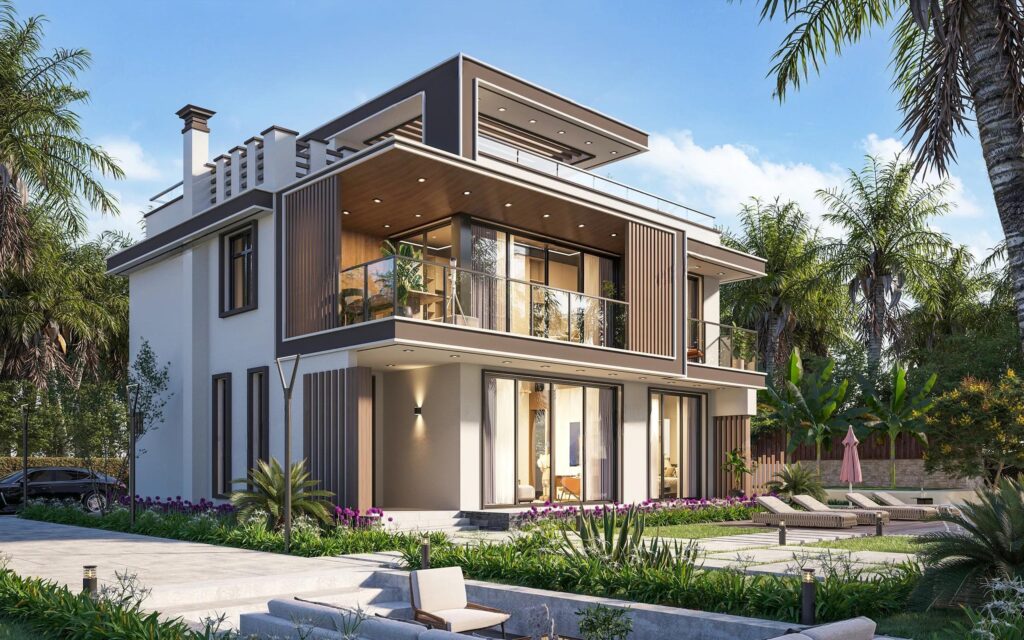
- The street presence, facade design, and site context of a building are all displayed by our exterior visualization service
- To illustrate scale and neighborhood integration, these pictures usually feature people, cars, nearby buildings, and landscaping.
- They are crucial for marketing materials, investor pitches, and zoning presentations.
- Accurate sunlight simulation for the particular location and time of day is necessary for high-quality exterior visualization.
- To accurately depict the design, it is frequently necessary to use multiple perspectives, such as corner views, elevated angles, and street perspectives at eye level.
Interior Visualization
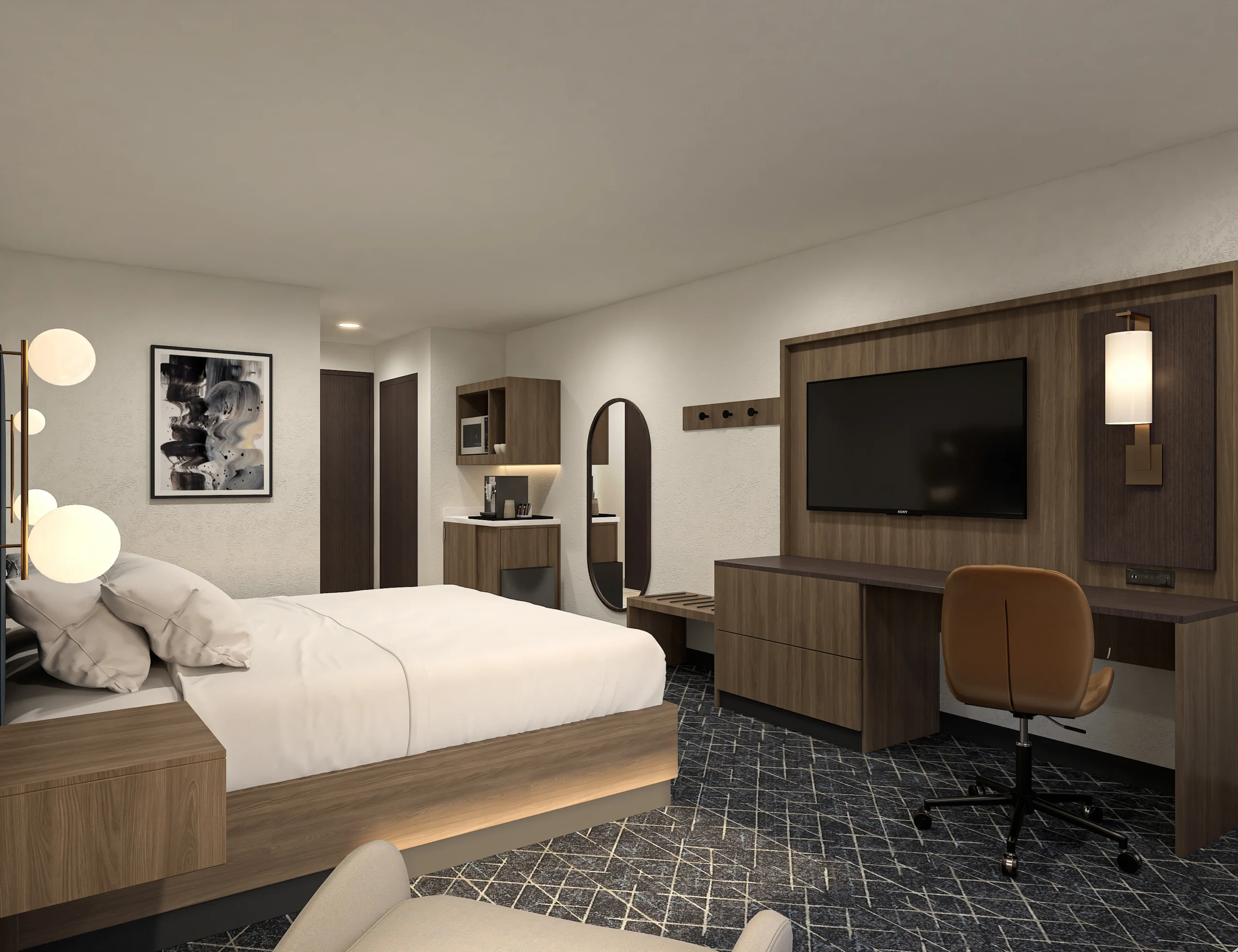
- The spatial experience, material selections, and lighting in rooms and circulation areas are the main topics of our interior visualization service.
- These are essential for commercial tenant marketing, residential sales, and hospitality design approval.
- Furniture, fixtures, artwork, and styling are all included in interior visualization to help viewers picture the finished area.
- Interior lighting is more complicated because indirect illumination, artificial lighting, and natural light must all be realistically balanced.
- Living rooms, kitchens, lobby areas, dining establishments, retail stores, and office settings are typical uses.
Aerial and Masterplan Visualization
- Aerial rendering service provide an elevated view of the site layout, building placement, circulation patterns, and landscape design.
- These are crucial for large residential communities, campus projects, and mixed-use developments where comprehension of the overall plan is more important than specific building details.
- Stakeholders can better understand the relationships between various structures, the integration of parking, and the distribution of open space with the aid of masterplan visualization.
- In order to show context and scale, these renders frequently incorporate nearby neighborhoods.
- They are especially useful for investor overviews and municipal presentations.
3D Floor Plans
- Compared to conventional 2D plans, 3D floor plans are easier to read because they display layouts with depth, color, and material indication.
- Because buyers can quickly understand room relationships, these are widely used in real estate marketing.
- Furniture placement is included in 3D floor plans, which demonstrate how areas can be utilized rather than just their measurements.
- When rapid spatial comprehension is crucial, they are ideal for websites, brochures, and sales presentations.
- These are a less expensive addition to full perspective renders offered by many 3D architectural visualization firms.
Architectural Animation and Walkthroughs
Example of architectural walkthrough animation used for real estate marketing
- 3D Animation and walkthrough simulate walking or flying through the project by moving through an area or around a building.
- For large-scale developments where static images are unable to fully convey the scope, these are very effective.
- Investor presentations, project launches, and website hero videos frequently use walkthroughs.
- Expect longer timelines and higher costs because production takes more time than still photos.
- Careful pacing and camera movement planning are necessary for effective animations; poorly done motion can come across as artificial or confusing.
360 Degree Virtual Tours
- Using a mouse or touchscreen, 360-degree tours let users explore an area from fixed points.
- Because they provide interactivity without requiring full VR equipment, these are becoming more and more popular for real estate marketing.
- Tours are accessible to buyers who live far away because they function well on websites and can be shared via links.
- They are easier to create and share than full animations, but they offer greater engagement than still photos.
- To enable thorough exploration, high-quality 360-degree tours need several points of view per area.
360° panoramic views and VR experiences allow viewers to explore a space interactively, looking in any direction and often moving between rooms or vantage points.
When immersive visualization makes sense:
- High-end residential sales where buyers need to experience the space before it’s built
- Design review sessions where clients need to evaluate sightlines and spatial relationships from multiple angles
- Projects where remote stakeholders can’t visit the site in person
- Interior design projects where clients need to experience scale and proportion firsthand
The trade-off is cost and complexity. 360° views and VR experiences require more production time than traditional 3D architectural rendering, so they’re typically reserved for projects where that level of immersion justifies the investment.
Virtual Reality Experiences
- VR experiences immerse viewers in a virtual world where they can explore areas at full scale and move freely.
- These are especially useful for upscale commercial, residential, and hospitality projects where clients must see the quality of the space before committing.
- VR offers unparalleled spatial understanding but necessitates specialized equipment (headsets).
- When assessing ceiling heights, proportions, and sightlines that are challenging to determine from screen-based visualization, the technology works especially well.
- VR is usually saved for projects where the investment justifies the additional cost because production costs are higher.
Software and Tools Used
3D Modeling Software
- Autodesk 3ds Max: Industry standard for architectural visualization, particularly strong for complex modeling and scene management.
- SketchUp: Popular among architects for conceptual modeling; often used as base geometry that’s refined in other software.
- Rhinoceros (Rhino): Preferred for projects with complex curved or parametric geometry.
- Blender: Open-source option gaining traction, with robust modeling and rendering capabilities.
- Revit models are frequently provided by architects and converted for visualization workflows.
Rendering Engines
- V-Ray: Most widely used in professional 3D architectural visualization companies, known for photorealistic results and material control.
- Corona Renderer: Increasingly popular for its speed and ease of use while maintaining high quality.
- Unreal Engine: Real-time rendering engine used for interactive visualization, VR, and increasingly for still images due to rapid iteration capabilities.
- Lumion: Real-time rendering focused on fast output and ease of use, though with some quality tradeoffs compared to ray-traced engines.
- Enscape: Real-time plugin integrated with design software, useful for quick visualization during design phases.
- D5 Render: Real-time rendering engine known for fast scene setup, realistic lighting, and smooth workflow for architectural visualization and presentations, but the output quality is not comparable to Corona renderer and V-Ray
Post-Processing Tools
- Adobe Photoshop: Essential for color correction, adding atmosphere, compositing elements, and final polish.
- Adobe Lightroom: Used for color grading and batch processing multiple images.
- After Effects: For animation post-production, adding motion graphics or atmospheric effects.
- Post-processing typically accounts for 20-30% of total production time on high-end renders.
- The goal is subtle enhancement, not masking poor rendering—post-processing should refine, not rescue.
What Defines High-Quality 3D Architectural Visualization

Realistic Lighting
- Light behaves naturally; shadows have realistic falloff and bounce, are soft when appropriate, and are hard when direct.
- Sun angle, color temperature, and shadow length all clearly indicate the time of day.
- Without overbrightening or washing out the scene, interior lighting displays accurate fixture intensity and color.
- Instead of allowing objects to float in space, subtle ambient occlusion and contact shadows ground them.
- The basis of realism is poor lighting, which is the quickest way to make visualization appear fake.
Accurate Materials and Textures
- Materials resemble their real-world counterparts: metals reflect correctly, stone exhibits natural patterning, and wood has grain direction and variation.
- Close-up renders display more detail than far-off views; texture scale corresponds to viewing distance.
- Reflectivity and glossiness correspond to the actual characteristics of the material; brushed metal is not mirror-like, and polished marble is not matte.
- Rather than being flawless and digital, materials are believable when they have a few flaws and wear patterns.
- Accuracy is ensured by material references from manufacturers or actual projects.
Correct Scale and Proportions
- Door heights, furniture measurements, ceiling clearances, and human figures are all appropriately sized in relation to one another.
- Inaccurate scale damages credibility and is instantly apparent to seasoned viewers.
- Accurate proportions are maintained by using reference measurements from real products or standard dimensions.
- Perceived scale is influenced by camera lens selection; proper focal lengths (35–50mm equivalents) prevent distortion.
- Scale errors are frequently caused during the modeling stage and cannot be corrected during post-processing.
Strong Camera Angles and Composition
- In order to convey design intent and generate visual interest, views are framed.
- Composition adheres to photographic principles: balance feels organic, focal points are obvious, and leading lines grab the eye.
- Eye level for interiors and suitable elevation for exteriors are the camera heights that correspond to realistic viewpoints.
- Instead of repeatedly presenting the same information, multiple perspectives tell a complete story.
- Even well-modeled projects appear amateurish due to poor camera work.
Attention to Detail
- Where visible, small components like switch plates, door hardware, grout lines, and mullion profiles are included.
- The placement of the entourage—people, vehicles, and landscaping—is deliberate and feels seamless rather than haphazard.
- The surrounding context, which includes nearby structures, topography, and vegetation suitable for the site, is accurate.
- Nothing appears to have been copied; realism is enhanced by variations in the materials, planting, and human figures.
- The details are typically where a good visualization differs from an exceptional one.
Post-Processing and Color Balance
- The final photos have balanced exposure, suitable contrast, and consistent color grading.
- Photographic feel is enhanced by atmospheric effects, such as slight vignetting, lens flaws, and subtle depth haze.
- Instead of being garish or oversaturated, colors feel harmonious and match client-specified palettes.
- Mood is improved through post-processing without appearing overly edited or manufactured.
- Expert 3D rendering and architectural visualization services are aware of the boundaries between excess and improvement.
Common Mistakes in 3D Architectural Visualization
Unrealistic Lighting

- Spaces that have excessively bright or flat lighting appear more like retail showrooms than well-designed spaces.
- Depth and dimension are lost when shadows are absent or too difficult.
- Experienced viewers can quickly spot inaccurate sun angles for the project location and stated time of day.
- Artificial lighting in the interior that is too uniform or too dim does not adequately highlight the area.
- Lighting errors need to be re-rendered because they cannot be completely fixed in post-processing.
Incorrect Scale and Proportions

- A common problem with inexperienced studios is furniture that is either too big or too small for the space.
- Standard dimensions must be followed for door heights, ceiling clearances, and fixture sizes.
- Credibility is immediately destroyed by human figures that are clearly out of scale.
- Even for non-professional viewers, oversized or undersized materials (such as brick, wood planks, and tiles) appear incorrect.
- Scale issues typically point to hurried modeling or insufficient reference gathering.
Poor Material References
- Recognizable, overused textures result from the use of generic material libraries without modification.
- Misalignment between visualization and actual construction results from materials that don’t match the specified products.
- Matte surfaces that should be glossy, or vice versa, are examples of incorrect material properties that look bad right away.
- Everything appears brand-new and manufactured due to the lack of material variation and weathering.
- Instead of using presets, quality studios create unique materials for every project.
Weak Camera Angles

- Views that fail to convey spatial quality or highlight the design’s salient features squander the chance.
- Even excellent designs can appear mediocre due to awkward framing, poor composition, or unrealistic viewpoints.
- Too many similar perspectives offer redundant information instead of a thorough comprehension.
- Client trust is damaged by angles that conceal issues rather than accurately depict the design.
- Instead of being random, camera placement should be thoughtful and strategic.
Ignoring the Target Audience
- Different styling is needed for investor presentation visualization than for end-user marketing.
- Renders that are too fashionable or stylized may quickly turn off conservative clients.
- The incorrect resolution or composition is the result of not taking into account how the images will be used (print vs. web, brochure vs. billboard).
- Luxury buyers expect different cues than buyers of affordable housing, so entourage and styling should be appropriate for the target demographic.
- If the visualization fails to connect with its target audience, even the best technical execution is in vain.
How to Choose the Right 3D Architectural Visualization Studio
Evaluating Portfolio Quality
- Examine finished projects that are comparable to yours in terms of building type, scale, and style.
- Instead of focusing only on a few exceptional pieces, look for consistent quality throughout the portfolio.
- Analyze the level of detail, composition strength, lighting realism, and material accuracy.
- Portfolios that resemble those of rival studios should raise suspicions because asset recycling and template rendering are frequent shortcuts.
- Instead of focusing on just one house style, the portfolio should show variety and flexibility.
Industry Experience and Specialization
- Studios that specialize in your building type are aware of the unique visualization requirements and typical difficulties.
- The priorities and target audiences of residential, commercial, hospitality, and institutional projects differ.
- Skilled studios don’t just follow orders; they anticipate issues and offer solutions.
- Inquire about the difficulties encountered in recent projects that are comparable to yours.
- Compared to generalists trying everything, specialized studios frequently produce better results.
Communication and Revision Process
- Explicit procedures for approvals, revisions, and comments avoid missed deadlines and scope creep.
- Recognize the number of revision rounds and what is considered additional scope.
- Throughout the project, responsive communication is just as crucial as technical excellence.
- Instead of speculating and creating work that is off-target, studios should ask clarifying questions up front.
- Vague deadlines, ambiguous deliverables, or trouble contacting the team are warning signs.
Turnaround Time and Reliability
- Optimistic promises that cause delays are not as valuable as realistic timelines.
- Be cautious of studios that promise unrealistically quick delivery because high-quality visualization takes time.
- Inquire about the current workload and the management of project scheduling.
- Professionalism and project management skills are demonstrated by regular on-time delivery.
- Reliability is important because missing marketing launch or presentation deadlines can be expensive.
Pricing Versus Value
- Seldom can professional projects be completed with the lowest cost.
- Recognize the modeling, revisions, particular views, resolution, and delivery formats that are included.
- Clear deliverables and transparent pricing avoid unforeseen expenses down the road.
- Value is determined by outcomes rather than just the cost per image, such as client approvals, sales velocity, and funding secured.
- Reputable 3D architectural visualization studios charge a fair price for the infrastructure and experience they offer.
3D Architectural Visualization for Different Industries
Real Estate Developers
Developers need 3D architectural visualization at multiple stages: securing investor funding, obtaining pre-construction sales or leases, and marketing completed units before they’re ready for occupancy.
How developers use architectural rendering to reduce risk:
- Pre-selling residential units or securing commercial tenants before construction finishes reduces financial risk
- High-quality renderings and walkthroughs give buyers and tenants enough confidence to sign contracts based on what the building will become
- Investors and lenders respond to visualization because it demonstrates that a developer has thought through design details and has a clear vision for the finished product
- Exterior renderings during community engagement and approval processes resolve neighbor concerns about scale, setbacks, and visual impact faster than verbal explanations
Professional architectural visualization services help developers move from concept to contract faster by giving stakeholders something concrete to evaluate and approve.
Architects and Interior Designers
Architects use 3D architectural visualization to translate design intent into something clients can evaluate before construction documents are finalized.
Why architects rely on architectural visualization services:
- Design revisions become exponentially more expensive as a project progresses—a material change that’s easy in a 3D model becomes a change order nightmare once construction starts
- Visualization helps manage client expectations by turning vague requests like “more natural light” into concrete design decisions
- For municipal or institutional projects, 3D renderings are often required as part of the approval process
- Review boards want to see how a building will look from public vantage points and how it fits within neighborhood character guidelines
- Submitting technical drawings alone rarely satisfies approval requirements
Interior designers use 3D visualization to align client expectations on material selections, furniture layouts, and lighting design before orders are placed.
Why interior rendering prevents expensive mistakes:
- A rendering that shows exactly how a specific fabric will look on a custom sofa under specific lighting conditions prevents costly ordering errors
- It shortens the approval process by showing the complete composition in context instead of asking clients to imagine how physical samples will work together
- For large-scale interior projects (hotels, office buildings, restaurants), visualization helps coordinate design intent across multiple stakeholders
- Owners, operators, and brand managers can all review the same renderings and provide feedback before fabrication begins
3D architectural rendering reduces the risk of misaligned expectations during installation, which is when changes become most expensive and disruptive.
Hospitality and Commercial Projects
- Visualization is necessary for stakeholder approval and tenant leasing in hotel, restaurant, retail, and office projects.
- Before committing to leases, prospective tenants or operators assess spaces through visualization.
- Rendering is a powerful way to illustrate brand standards and design coherence.
- Visualization is used in investor presentations to convey market positioning and project vision.
- By showcasing a project’s marketability and viability, visualization aids in obtaining funding.
Marketing and Sales Teams
- For unbuilt projects, 3D architectural visualization rendering is essential to all marketing materials.
- Promotional events, advertising campaigns, and website launches all need eye-catching imagery.
- High-quality visualization enhances social media content more than construction photos or floor plans.
- Brochures, billboards, and sales center displays are examples of print materials that require high-resolution, expert visualization.
- If the quality of the visualization does not align with the project positioning and price point, marketing budgets are squandered.
Future of 3D Architectural Visualization
Real-Time Rendering
- Near-photorealistic quality is now produced by real-time engines with immediate feedback.
- When lighting and material changes appear instantly instead of requiring hours of rendering, design teams can iterate more quickly.
- During meetings, client presentations become interactive—you can change the time of day, finishes, or viewpoints in real time.
- Real-time workflows are becoming more and more feasible for final delivery as the gap between real-time and ray-traced quality closes quickly.
- This technology lowers production
Virtual Reality and Interactive Experiences
- The use of VR is increasing as hardware becomes more accessible and reasonably priced.
- Scale, proportion, and spatial quality are experienced by clients in ways that are unmatched by screen-based visualization.
- Clients can explore spaces at their own pace and concentrate on what matters to them with interactive walkthroughs.
- Geographical barriers are eliminated because remote clients can experience projects from any location.
- Projects that don’t provide immersive experiences could be at a competitive disadvantage as VR becomes commonplace rather than innovative.
AI-Assisted Visualization
- Certain visualization tasks, such as texture creation, object placement, and style transfer, are being accelerated by AI tools.
- Realistic material aging, seasonal vegetation changes, and lighting variations can all be predicted by machine learning.
- Manual placement time is decreased by automated asset populations, such as furniture, landscaping, and entourage.
- AI-enhanced post-processing and upscaling can increase productivity without compromising quality.
- However, human judgment on composition, lighting, and design communication is still crucial, and AI currently complements rather than replaces talented visualization artists.
Digital Twins and Virtual Environments
- Certain visualization tasks, such as texture creation, object placement, and style transfer, are being accelerated by AI tools.
- Realistic material aging, seasonal vegetation changes, and lighting variations can all be predicted by machine learning.
- Manual placement time is decreased by automated asset populations, such as furniture, landscaping, and entourage.
- AI-enhanced post-processing and upscaling can increase productivity without compromising quality.
- However, human judgment on composition, lighting, and design communication is still crucial, and AI currently complements rather than replaces talented visualization artists.
Frequently Asked Questions ( FAQs )
What Inputs Are Required to Start a Project?
- Sections, elevations, and architectural plans—ideally in CAD format (DWG, RVT), though PDFs can be used if needed.
- For accuracy, use product references, finish schedules, or material specifications.
- any current 3D models, though rendering optimization will probably be necessary.
- Topography, nearby structures, and landscape plans are examples of site context information.
- Reference projects or inspiration photos that reflect the intended aesthetic and caliber.
- Clearly state the target audience, intended use, and particular viewpoints that are required.
How Long Does a 3D Visualization Project Take?
- Simple single-image projects: 1–2 weeks from brief to final delivery.
- Multiple views or complex projects: 3–5 weeks depending on scope.
- Large-scale developments with multiple building types and extensive site work: 6–10 weeks.
- Animation projects: 4–12 weeks based on length and complexity.
- Timeline depends on input quality, revision rounds, and current studio workload.
- Rush projects are possible but require schedule adjustment and premium pricing.
How Many Revisions Are Included?
- Most professional studios include 2–3 rounds of revisions in base pricing.
- What constitutes a “revision” should be clarified upfront—minor tweaks versus significant changes.
- First round typically addresses material adjustments, lighting refinements, and entourage placement.
- Second round handles fine-tuning based on stakeholder feedback.
- Scope changes (new views, different camera angles, major design changes) are typically priced separately.
- Clear communication and detailed initial briefings minimize revision rounds.
Can Visualization Be Done Without CAD Drawings?
- Yes, but it’s more time-consuming and expensive.
- Studios can work from PDFs, sketches, or even verbal descriptions, but accuracy suffers and modeling time increases.
- The more complete the documentation, the fewer assumptions required and the more accurate the output.
- For early-stage visualization, rough layouts and dimensions can work if photorealism isn’t required.
- Investment in proper documentation upfront reduces visualization costs and revision cycles later.
What File Formats and Resolutions Are Delivered?
- Standard delivery is high-resolution JPEG (4K–8K) suitable for print and large-format display.
- TIFF files are available if needed for publication or archival purposes.
- Some studios provide layered PSD files allowing marketing teams to adjust elements like sky, entourage, or text overlays.
- Animation formats include MP4 for web and higher-quality formats (ProRes, H.265) for presentation or broadcast.
- Resolution and format requirements should be confirmed during project setup to avoid re-rendering.
Final Thoughts on 3D Architectural Visualization
From being a nice-to-have luxury, 3D architectural visualization is now necessary for projects. Whether you’re marketing to buyers, presenting to clients, or obtaining funding, the quality of your visualization will determine whether your project proceeds smoothly or stalls due to misunderstandings and revision cycles.
Outcomes are what distinguish mediocre visualization from exceptional visualization, not just aesthetics. High-quality renders secure approvals with fewer revisions, close sales more quickly, and effectively convey design intent to all project participants. Selecting the best 3D architectural visualization company requires assessing communication procedures, industry experience, portfolio quality, and realizing that cost is a reflection of the infrastructure and knowledge needed to produce expert results.
The fundamentals—accurate modeling, realistic lighting, strong composition, and clear communication of design intent—remain constant as real-time rendering, virtual reality, and AI-assisted workflows continue to progress. The greatest value is produced by studios that are adept at both technical execution and strategic thinking about how visualization supports the particular objectives of each project.
The question for architects, developers, and designers is not whether or not to invest in 3D architectural visualization, but rather how to make sure that investment yields the competitive advantage, clarity, and confidence your project needs.